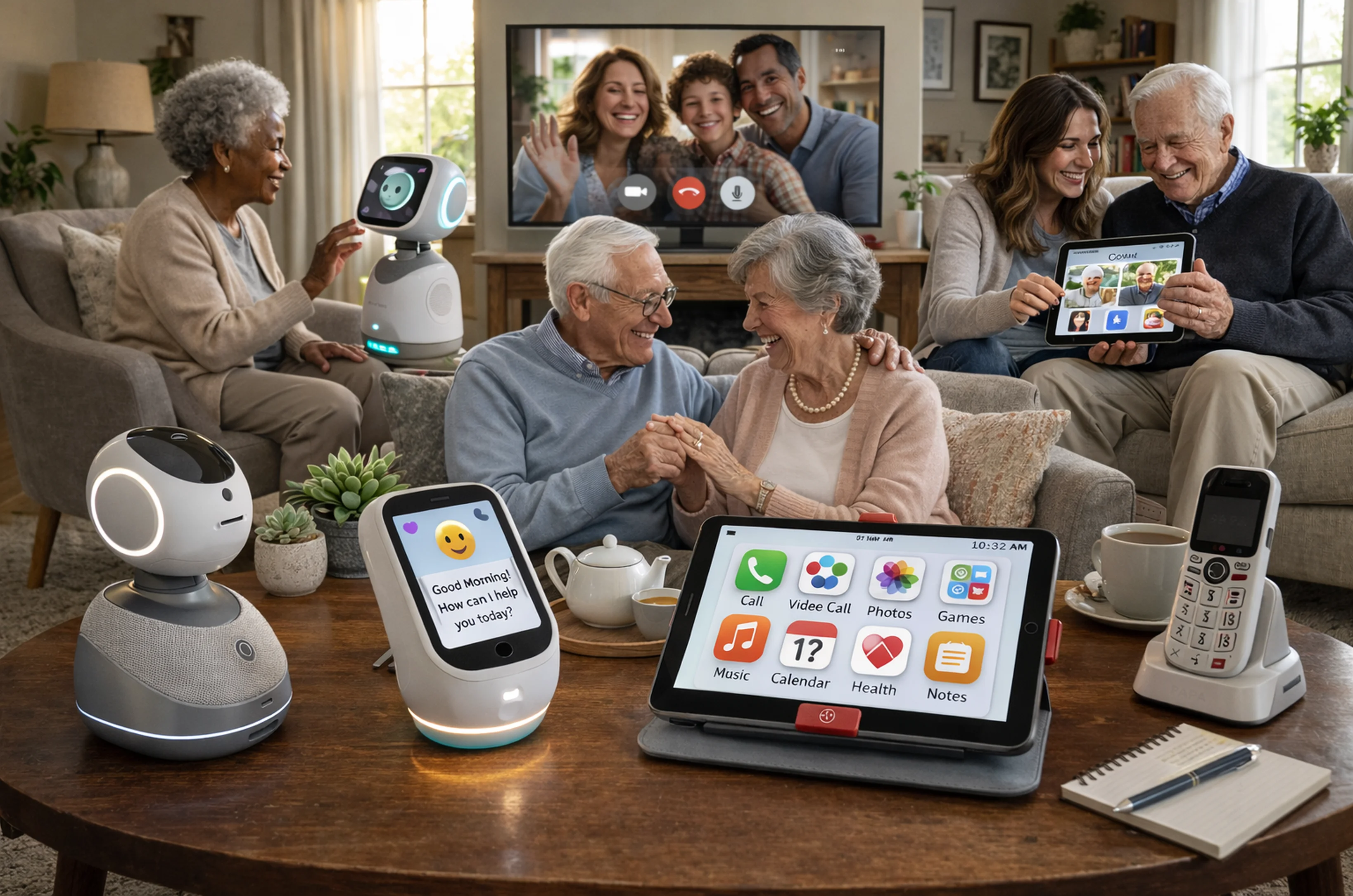
If you are looking for ways to keep a parent or grandparent connected, you have probably come across several options — AI companions, specialized tablets, human visitor programs, in-home aides. Each one approaches the same problem differently, with different tradeoffs in cost, convenience, and the kind of care they can actually provide.
There is no perfect answer that works for every family. But there are honest answers. This guide breaks down the most common options so you can make a clear-headed decision for your situation — without wading through marketing language.
This article is for general education only. For medical, clinical, or safety decisions, consult a licensed professional.
Quick comparison
| Feature | Ultaura | ElliQ | GrandPad | Papa | In-Home Aide |
|---|---|---|---|---|---|
| Type | AI voice calls | AI robot | Senior tablet | Human companions | Human caregiver |
| Requires device purchase | No | Yes ($250 setup) | Yes (~$200) | No | No |
| Monthly cost | From $19/mo | ~$50/mo | ~$40/mo | Insurance-based | $36/hr avg |
| Works on existing phone | Yes (any phone) | No | No | N/A | N/A |
| Daily companionship | Yes (scheduled) | Yes (proactive) | Limited | No (limited hours) | Depends on budget |
| Safety monitoring | Yes | No 911 capability | No | No | Yes (if trained) |
| Memory and continuity | Yes (remembers conversations) | Yes | No | No (different people) | Depends on consistency |
| Setup complexity | 5 minutes | Professional install | Moderate | Insurance enrollment | Hiring process |
| Free trial | 14 days | No | No | N/A | No |
Ultaura — AI voice companion
Ultaura calls your loved one at scheduled times — morning, afternoon, or evening — for natural, friendly conversation. It works on any phone: landlines, cell phones, flip phones. No devices to purchase, no apps to install, no WiFi required on your parent's end.
The calls feel like a check-in from someone who knows them. Ultaura remembers what was discussed in previous calls — a doctor's appointment coming up, a grandchild's birthday, a favorite TV show — and weaves those details into the conversation naturally. If something sounds off, the system logs mood and wellness signals so you can review them from the family dashboard.
Reminders for medications, appointments, and daily tasks can be built into the call flow instead of arriving as separate alerts your parent might ignore.
Key strengths: Lowest cost of any option here ($19/month for the Care plan). Works on existing hardware. Tracks mood and wellness over time. Safety monitoring detects distress keywords and can notify trusted contacts. 14-day free trial.
Limitations: AI-based, not human. Requires your parent to answer the phone. Currently US-only.
Best for: Families who want affordable, consistent daily connection without asking a senior to learn new technology.
ElliQ — AI robot companion
ElliQ is a tabletop robot with a small screen, made by Intuition Robotics. It sits on a table near your parent and proactively starts conversations — it might suggest a breathing exercise, ask how they slept, or prompt a video call with family. Unlike most other options, ElliQ does not wait to be addressed; it reaches out on its own.
The device can run health check-ins, guide light cognitive exercises, play games, display family photos, and facilitate video calls. It also learns preferences over time and adapts its tone and topics.
Key strengths: Physical presence in the room. Proactive — it starts conversations rather than waiting. Good for cognitive engagement exercises and brain games. Video calling built in.
Limitations: $250 setup fee plus approximately $50 per month (about $600 per year). No emergency response capability — it cannot call 911 or alert emergency contacts. Requires WiFi. Your parent has to be comfortable with a robot on the table. Some seniors find it unsettling; others love it.
Best for: Tech-comfortable seniors living alone who want an always-present companion and are open to a physical device.
Sources: ElliQ.com, The Senior List — ElliQ review
GrandPad — senior-friendly tablet
GrandPad is a simplified tablet built for seniors, with large icons, a minimal interface, and built-in cellular so it works without WiFi. The focus is on video calling, viewing family photos, playing simple games, and listening to music. It comes preloaded with contacts that family members manage, and it filters out spam and unknown callers.
Setup is moderate — someone needs to configure the contacts and settings — but day-to-day use is designed to be frictionless for someone who has never owned a smartphone.
Key strengths: Large, simplified interface. Built-in cellular (no WiFi needed). Secure, curated environment — no accidental internet browsing or phone scams. Good for families who want video calling as the primary connection method.
Limitations: ~$200 device cost plus about $40 per month. It is a tablet, not a companion — it does not initiate conversation or check in proactively. Requires some comfort with touchscreens. No wellness monitoring or safety features.
Best for: Seniors who are comfortable with touchscreens and whose primary need is video calling and media.
Sources: SeniorLiving.org — GrandPad review, Reviewed.com — GrandPad review
Papa — human companion service
Papa is a platform that connects seniors with "Papa Pals" — vetted companions who provide in-person visits for social connection, light errands, transportation, and help around the house. Most Papa coverage comes through Medicare Advantage plans rather than direct payment.
A Papa Pal might drive your parent to a grocery store, sit with them for conversation, or help organize mail. The visits are real, in-person human interaction — which is something no AI or device can fully replicate.
Key strengths: Real human contact. Physical task help (errands, transportation, light housework). Available across all 50 states through insurance.
Limitations: Coverage through insurance typically means around 36 hours per year — roughly three hours per month, not daily companionship. Each visit may be a different person, which limits continuity and relationship-building. Several major insurers have scaled back or ended their Papa partnerships. If your parent's plan does not cover Papa, out-of-pocket costs apply.
Best for: Seniors who need occasional in-person company and practical help, and who have an insurance plan that covers it.
Sources: Papa.com, The Senior List — Papa Pals review
Hiring an in-home aide
An in-home aide provides the most comprehensive support — physical care, companionship, medication assistance, and safety oversight — but at a cost that reflects that scope. Rates vary significantly by region. The national median for non-medical home care is around $36 per hour, which means even part-time coverage adds up quickly.
Consistency matters enormously in this category. A family that has the same aide for months builds a real relationship with meaningful continuity. High turnover — which is common in the home care industry — disrupts that.
Key strengths: Full human presence. Physical care is possible (dressing, bathing, mobility). Relationship can deepen over time. Adaptable to changing needs.
Limitations: Expensive. Median cost exceeds $6,000 per month for part-time help. Finding and retaining reliable caregivers is genuinely hard. High industry turnover. Hiring, vetting, and managing a caregiver is its own full-time task.
Best for: Seniors who need physical assistance alongside companionship, and families who have the budget and bandwidth to manage the hiring process.
Sources: SeniorLiving.org — home care costs, A Place for Mom — in-home care costs
The option most families default to: doing nothing
This is worth naming directly, because it is the most common choice — not out of neglect, but out of overwhelm. You are not sure which option is right. You do not want to make your parent feel watched. You are waiting for the right moment.
The research on what happens in the meantime is not comfortable reading:
- 1 in 3 older adults experiences chronic loneliness, according to AARP and the National Academies of Sciences.
- Social isolation carries a mortality risk comparable to smoking 15 cigarettes a day, according to research by Holt-Lunstad et al..
- Socially isolated seniors have approximately 60% more emergency room visits than connected seniors, per Innovation in Aging, 2024.
- 78% of family caregivers report significant burnout, according to A Place for Mom's 2025 caregiver survey.
The cost of inaction is not zero. It shows up later, in emergency interventions, accelerated cognitive decline, and caregivers who have nothing left to give.
How to choose
No comparison table can make this decision for you, but these questions narrow it down quickly:
Does your parent need physical assistance, or primarily companionship? If physical — in-home aide is necessary. If companionship — AI or device options work.
How comfortable is your parent with new technology? A senior who has never used a smartphone is unlikely to embrace a tablet or a robot. A phone call requires no learning at all.
What is your realistic monthly budget? Ultaura starts at $19/month. ElliQ runs ~$50/month plus the setup cost. An aide costs hundreds or thousands per month depending on hours.
Do you need daily contact, or occasional visits? For daily touchpoints, only Ultaura and ElliQ are designed to provide them consistently. Papa and aides depend heavily on scheduling and budget.
Do you want wellness insights over time? Ultaura and ElliQ both track patterns. Tablets and human visits generally do not generate structured data you can review.
A final thought
Most families do not need one perfect solution — they need a baseline that is sustainable. A daily AI check-in call that costs less than a streaming subscription is a very different proposition than hiring an aide. They are not in competition; they solve different problems.
If daily contact, safety awareness, and affordability are the priorities, Ultaura is designed exactly for that. If you want to see how it works before committing to anything, you can try it free for 14 days — no device purchases, no setup fees.
Whatever you choose, choosing something is better than waiting for the situation to get harder.
Health and safety note: this article is for general education, not medical or clinical advice. For emergencies, call 911. For mental health crises, call or text 988.